Spring equations and Pendulum equations
Pendulum equations are somehow similar to those of Spring shown in textbooks. This is expected as you see the movement of a spring with a weight or a force by hand carefully or in a slow motion and the movements of a pendulum. But most of the cases a spring tends to stop its <back and forth> motion so soon and back to and stay at the original position while the <back and forth> movement of a pendulum keeps longer. I think the equations of these movements have profound and deep meanings of Nature. Let us look at them with some efforts and possibly with some fun from some experiments.
Spring equations
Hooke's Law (from wiki - July, 2016)
"
Hooke's law states that


Hooke's law for a spring is often stated under the convention that F is the restoring (reaction) force exerted by the spring on whatever is pulling its free end. In that case the equation becomes

"
The equations are simple. F (Force) (variable) is proportional to X (variable) while k is constant or a constant. The restoring (reaction) force is difficult to see but you can feel this force when you pull or push a spring. The restoring (reaction) force is interesting in that
As the above two equations show the magnitude of the applied force F is same as that of the restoring (reaction) force F but they are in the opposite direction.This is one of the Newton's laws. They are exactly balanced and canceled out. This Newton's law is very universal, works everywhere.
A spring shows <back and forth> movement but the above spring equations (actually only one equation) do not show any pendulum <back and forth> periodical movement. We may be back to these after reviewing pendulum equations.
From wiki <Pendulum> July, 2016
"
Pendulum equations
The period of swing of a simple gravity pendulum depends on its length, the local strength of gravity, and to a small extent on the maximum angle that the pendulum swings away from vertical, θ0, called the amplitude. It is independent of the mass of the bob. If the amplitude is limited to small swings, the period T of a simple pendulum, the time taken for a complete cycle, is:

(Note: θ0 in radian. 1 radian, in this case, is 2 x 3.14 / L. g = 9.8m / sec x sec. So if L = 1 m, Inside the square root becomes 1 m / 9.8m / sec x sec) ---> about 0.1 x sec x sec. 0.1 square root is about 0.316 (happens to be close to 3.14/10). Then this the square root becomes 0.314 sec. 2 x 3.14 x 0.314 sec = 1.971 sec, which means T = 1.971 sec, almost 2 sec. Because of the square root nature, 0.25 (or 1/4) m long L makes T as 1 sec.)
.............
(skipped)
For small swings the pendulum approximates a harmonic oscillator, and its motion as a function of time, t, is approximately simple harmonic motion:
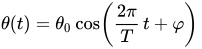
 is a constant value, dependent on initial conditions.
For real pendulums, corrections to the period may be needed to take into account the buoyancy and viscous resistance of the air, the mass of the string or rod, the size and shape of the bob and how it is attached to the string, flexibility and stretching of the string, and motion of the support.
"
The equation (1)
Why 2π ? Good question.
2π means <one cycle> and the unit is radian (or in the angular system / dimension).
T
--- means time / one cycle in radian, i.e. Still Period.
2π
In the root
L = Length of the pendulum string as well as the radius of pendulum circular (angular) motion. unit <m>
g = gravity, unit <m/sec x sec>.
Therefore
L
--- : unit is <sec x sec> which is in the root.
g
So The equation (1) does make sense in dimension. Radian is the special unit.
For more deeper understanding we must go further to wiki <Pendulum (Mathematics)>.
Pendulum (mathematics)
For a more accessible and less technical introduction to this topic, see Introduction to pendulum (mathematics). (---> This is the above copy <Pendulum>.)
The mathematics of pendulums are in general quite complicated. Simplifying assumptions can be made, which in the case of a simple pendulum allows the equations of motion to be solved analytically for small-angle oscillations.
Simple gravity pendulum
A so-called "simple pendulum" is an idealization of a "real pendulum" but in an isolated system using the following assumptions:- The rod or cord on which the bob swings is massless, inextensible and always remains taut;
- The bob is a point mass;
- Motion occurs only in two dimensions, i.e. the bob does not trace an ellipse but an arc.
- The motion does not lose energy to friction or air resistance.
- The gravitational field is uniform.
- The support does not move.
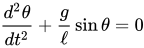
- (Eq. 1)
"
This equation is complicated and also suddenly introduced to you and again as an rule or an order which requests you to memorize it though you do not have to do it. But you can guess or find
1) The first part of the left hand side of the equation reminds us of the acceleration and
2) the 2nd part g/l reminds you of the above L/g. And gravity is force, which is <mass x acceleration>. Complication is <g/l> is attached <sin>.
3) the point is θ. θ is the angular displacement. Unit is radian.We must be familiar with this.
This equation comes (derives) from several ways but the most commonly found is
"
From wiki <Pendulum (Mathematics)> July, 2016
"
"Force" derivation of (Eq. 1)

Figure 1. Force diagram of a simple gravity pendulum.
Consider Figure 1 on the right, which shows the forces acting on a simple pendulum. Note that the path of the pendulum sweeps out an arc of a circle. The angle θ is measured in radians, and this is crucial for this formula. The blue arrow is the gravitational force acting on the bob, and the violet arrows are that same force resolved into components parallel and perpendicular to the bob's instantaneous motion. The direction of the bob's instantaneous velocity always points along the red axis, which is considered the tangential axis because its direction is always tangent to the circle. Consider Newton's second law,

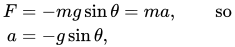
This linear acceleration a along the red axis can be related to the change in angle θ by the arc length formulas; s is arc length:
For a more accessible and less technical introduction to this topic, see Introduction to pendulum (mathematics). (---> This is the above copy <Pendulum>.)
The mathematics of pendulums are in general quite complicated. Simplifying assumptions can be made, which in the case of a simple pendulum allows the equations of motion to be solved analytically for small-angle oscillations.
Simple gravity pendulum
- (Eq. 1)
"
This equation comes (derives) from several ways but the most commonly found is

No comments:
Post a Comment